This subject has been floating around in my mind for some time. I have been wanting to tackle some muscles of the pelvis and hip that aren’t spoken enough of (until you’re rehabilitating them due to an injury) and tend to be problematic. A feeling of “tightness” may very well be the first sign that a dedicated set of exercises and consistent routine are in order. For this blog post, I’ve chosen three muscles, by far not an exhaustive list. I’ll dive right into it!

A feeling of “tightness” may very well
be the first sign that a dedicated set of exercises
and consistent routines are in order.
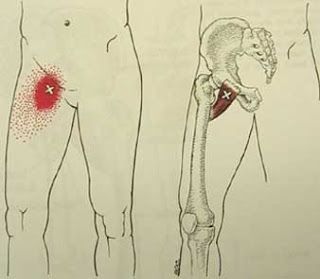
Pectineus, I have a personal beef with pectineus. This muscle has been causing pain in my right thigh. It contains a trigger point that radiates with a dull ache around my groin. Pectineus can be found in the medial upper thigh. It attaches from the pubis bone to the medial femur (upper inner thigh bone) just below the hip joint. This muscle serves to adduct and flex the femur. It moves the thigh in front of the body. It also pulls the thigh toward the midline.
Its primary action is adduction and flexion of the thigh.
If you routinely play soccer or hockey or are in the habit of sitting cross-legged for a prolonged time, this muscle gets tense since it’s chronically overloaded. If you have limitations in this muscle, your gait and squatting mechanics are affected, and your risk of a groin pull is high (especially in sports activities that involve quick sudden movements).
Following a systematic stretch routine would be beneficial if it feels tight and your full range of motion is affected. The first step would be a self-myofascial release (SMR), commonly known as foam rolling. Why? Muscles, tendons, fascia, and skin have mechanoreceptors that respond to external tension, pressure, and vibration by relaxing the tone in the muscle, thus facilitating a static stretch. When doing SMR, you are searching for those trigger points that tend to feel tender, sore, or painful. Check out the video below, which targets pectineus.
SMR is followed by a static stretch held for a minimum of 30 seconds.
The last step would be to activate the opposing muscle group. For this example, the opposing muscle group are the hip abductors; gluteus medius, gluteus minimus, and tensor fasciae latae. An exercise that would engage these muscles is the prone hip extension. Following this with an inner thigh stretch, such as the straddle stretch, would be ideal.

Tensor Fasciae Latae
TFL
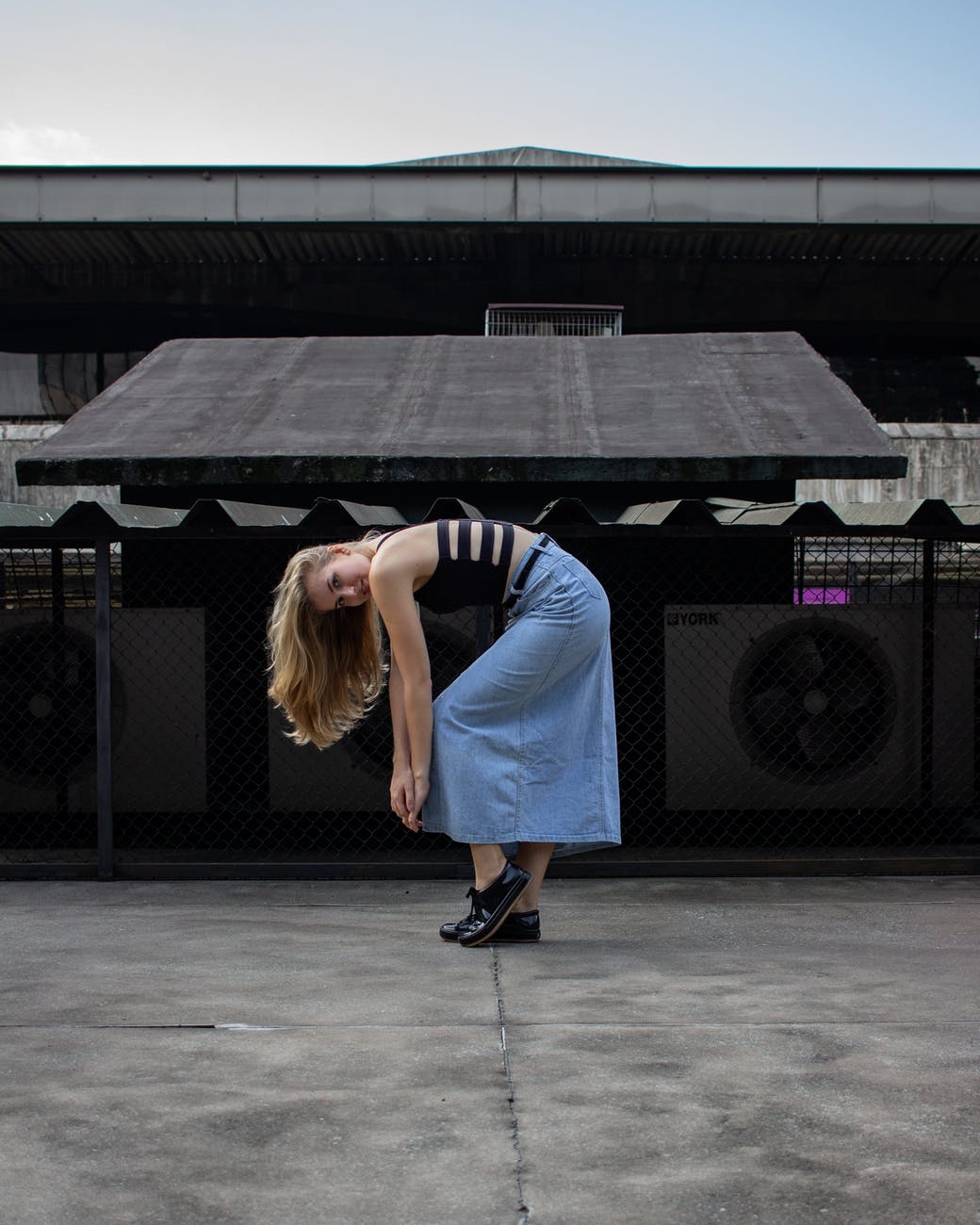
This muscle (TFL for short) is fun but does not appear in many articles. A strong TFL with proper extensibility will allow you to bust a move like the one above! Okay, not solely on its own, but it is vital for pelvic stability.
TFL is a small superficial muscle located right below the iliac crest, what most people think of as the hip bone, which is the ilium of the pelvis (see photos below). It continues downward to merge with the iliotibial tract (commonly referred to as the ITB band), which also merges with the connective tissue of the gluteus maximus. The ITB band is a wide tendinous sheet of fascia; think of it as a large broad tendon that attaches to the lateral condyle of the tibia (shin bone).
Through its connection with the ITB band, it assists in knee flexion and lateral rotation of the lower leg. It’s a critical muscle in stabilizing the pelvis during ambulation, helping anchor one hip while the other rises and swings the leg forward.
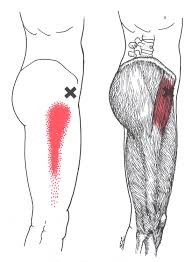
With all this great power comes great responsibility! These muscles get stressed from running on uneven surfaces or immobilizing a limb for an extended period (i.e. wearing a leg brace). If it’s chronically tight, you might have issues with gait, pain deep in the hip, or patella tracking dysfunction via its connection to the ITB band. The video below demonstrates an SMR technique for TFL.
The Psoas
the main bridge between your spine and lower body
The Iliopsoas are a feisty group. These muscles cause quite a stir! Everyone who sits for an extended period may very well have tight iliopsoas or low back pain. Why? The psoas are a significant bridge between the spine and the lower body. When we sit, they are forced into a shortened position. Over time, the muscles become adaptively short (constricted, lose extensibility) and might compress the lumbar discs, leading to pain.

This is where I preach the importance of posture and ergonomics; If sitting for an extended time consider adding lumbar support; a folded towel placed under and across the hips to reduce tension; computer should be placed at eye level; elbows at 90 degrees, wrist neutral; get up every 30 minutes to decrease tension and ease circulation of fluids;
The psoas comprises two muscles, the illiacus, psoas major and psoas minor. The psoas major originates from the front of the lower vertebrae (T12-L5), travels through the pelvis, and inserts at the medial femur below the hip joint (specifically, the lesser trochanter of the femur). The iliacus is located in the iliac fossa (for a visual, cup your hand slightly; the fossa would be the cup) and also attaches to the lesser trochanter of the femur. Both muscles flex the hip, laterally rotate the hip, and anteriorly tilt the pelvis. Psoas major assists in lateral flexion of the spine. It’s a primary low-back stabilizer and allows you to flex your trunk forward when your legs are stabilized. If you’ve ever done a traditional sit-up and felt more strain in your hips than your abs, it’s because the psoas completed the action, not the abdominals.
Aside from sitting for an extended period, other things that cause strain to the iliopsoas are running downhill – if you’re into that sort of stuff, trunk rotation with the feet fixed in place, and overload from bad postural habits. The iliopsoas are difficult and uncomfortable to perform SMR. They are located within deep structures. If you’re experiencing tension in your hip flexors, a trained manual therapist would know how to assess and address them safely and effectively.
The real trick with the iliopsoas is identifying if they are not just tight but are they weak? I’ve linked a video below that explains this very well.
I hope this post has been insightful for those experiencing hip tension. Remember, the body is unique in its construction. The information on this site is not intended as a substitute for professional medical advice. If pain is present and tension is chronic, see your doctor for the appropriate treatment.
If you’re interested in working with me and would like a conveniently delivered customized training routine, head to my Contact page. I look forward to speaking with you!
Stand tall Breathe deep~
Corina
 Integrative Fitness Therapy